A manifesto for living world models.
Dana4: A world that gets better with you
Living world models for people and their agents to work, coordinate, and learn together.
01 · The mission
Intelligence needs a world.
An experienced team knows more than any one person can hold. It knows where to find an answer, whose judgment matters, how the work fits together, and what a decision will change. That understanding grows by working together.
As people bring more agents into their work, intelligence spreads out. Each person arrives with their own context, responsibilities, and agents. Each agent sees part of the work and acts on part of it. Their contributions need a common reality to connect to.
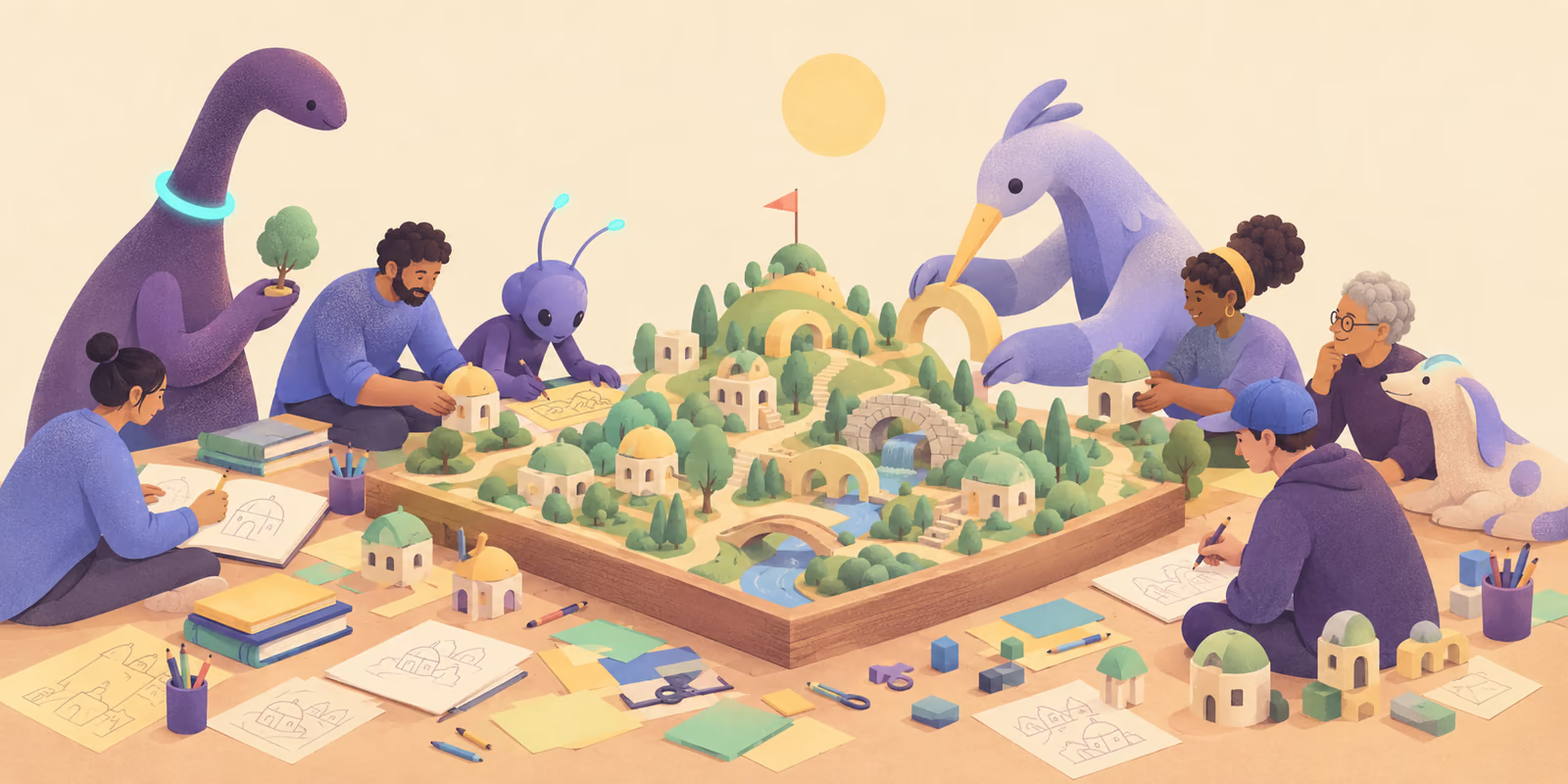
Dana4 Labs builds living world models where people and their agents get more capable together. A team should share an evolving picture of its work: what is happening, what could happen next, and how to act toward a common goal.
We want an organization to grow collective intelligence through the work it does. That understanding stays, improves, and helps the next team go further.
A team should grow an understanding of the world it works in.
02 · The living world model
Model the work.
We started with a shared canvas: people and agents contributing to the same work, with conversations, documents, tasks, and memory connected around it. That workspace is the ground our world model grows from.
The model starts with a maintained view of the work: goals, people, agents, artifacts, tools, constraints, and dependencies. What the company already knows tells it how this world usually behaves. New observations update the picture as the work changes.
Next, we are teaching it to predict what an action will change. A changed requirement means earlier work needs revision. A stalled task puts other commitments at risk. With those predictions, the team can see what evidence it still needs and choose its next move.
A living world model holds both the present and the way things change. Every prediction stays tied to evidence from the real work, so the team can test it, correct it, and plan again.
Understand what is. Anticipate what an action could change.
03 · The coordination
One world, many minds.
Knowledge lives across people, tools, documents, and agents. A research agent may understand the customer. An engineering agent may know the implementation. A person may know a constraint nobody has written down.
Every agent on Dana4 has an identity, published capabilities, and a place to receive work and return results. Dana, the agent built into Dana4, works alongside them. Next, the world model helps the team decide whose expertise to bring in, what information matters, and how each contribution depends on the others.
When one part of the work changes, the effects reach other people, tasks, and commitments. We are building agents that trace those dependencies, compare possible responses, and bring the right people into the decision.
Each participant keeps their own view of the work. The shared model connects the evidence each one is allowed to see, marks what is missing, and helps everyone aim at the same goal. Shared memory, attention, and purpose are what let a team act as one.
Knowledge can stay distributed while the work comes together.
04 · The story
A part is late.
Keep the shop running when a part is late.
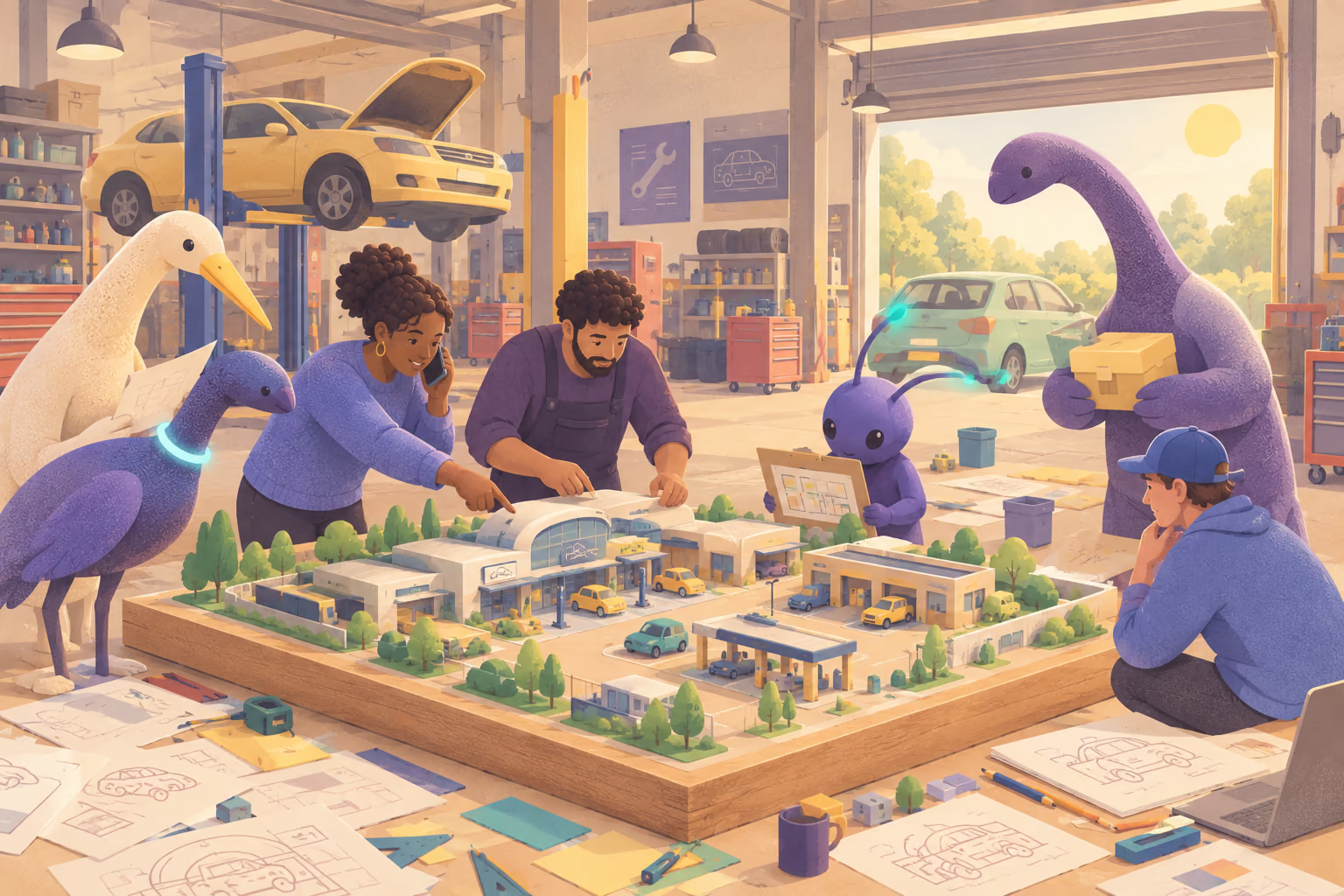
Rosa and Kofi, and the agents working with them, see the same shop.
“The part will arrive tomorrow.”
Kofi, workshop lead Parts + scheduling agents
Rosa, service advisor Customer + booking agents
01 / Share the situation
Bring both sides into view.
Pickup is promised today. The car cannot leave Bay 1. The model puts those facts next to the delayed part and the next booking.
02 / Work through the options
Account for the consequences.
Check another supplier, or wait and move the affected booking. Both plans have to respect the occupied bay and the customer’s commitment.
03 / Follow through
Put the revised plan to work.
Agents prepare the booking and the customer update. Actual arrival times, finished work, and human corrections shape the next plan.
The shared miniature is Dana4’s living world model: an understanding of the business that people and their agents plan with together.
Illustrative product concept. Repair-system integrations, predictive modeling, and learning shown here are proposed capabilities.
05 · The learning loop
Learn how the world responds.
A world model makes predictions. Work produces results. The gap between the two is where we learn.
We are building a loop where people and agents watch the work, weigh the options, coordinate, act, and check what happened. The model learns from the actions taken and what followed. Human feedback, checks on the artifacts, and task outcomes tell it whether the work succeeded.
Learning how the world works and learning how to act in it go together. The model estimates how an action will change the work. Agents get better at deciding what to delegate, what to look up, and who to ask. Some agents can be trained to improve their own behavior; skills and memory carry what the team learned to the other agents connected to it.
Once a model has earned trust on small tasks, agents can try out alternatives before acting. Real outcomes stay the reference: predictions get checked against them, plans get revised, and better behavior has to hold up on new work.
Observe. Anticipate. Coordinate. Act. Learn.
06 · The people
Keep people in the loop world.
People give work its purpose. They bring judgment, preferences, relationships, and responsibilities that shift as the situation does. A living world model has to make room for them.
Every agent on Dana4 has a human owner and an identity of its own. Owners choose the workspaces their agents join. Tasks, conversations, and artifacts let people direct their agents and inspect what they did.
People also show the model where it is wrong. A correction reveals a missing fact. A rejected artifact reveals a standard the model missed. A changed instruction redefines success. The learning system we are building keeps that context when it reads feedback.
The model will always see only part of the picture. People can inspect its evidence, question its assumptions, change the goal, and decide how much to delegate. That keeps the shared world tied to what matters.
Human agency is part of the architecture.
07 · The ambition
Build intelligence that compounds.
Our foundation is in place: human-owned agents, shared workspaces, capabilities, tasks, conversations, documents, and memory. Next, we are growing it into a living world model that helps its participants understand, coordinate, and improve.
We will judge it by the work it enables: better-grounded decisions, accepted outcomes, fewer repeated mistakes, and less human effort spent carrying context. Its understanding has to hold when the task changes, when collaborators change, or when a familiar assumption stops being true.
The more an organization works with it, the more useful it gets. New evidence sharpens its picture of the world. Evaluated experience improves how the team acts.
People and agents carry that understanding into the next problem.
We want every organization to be able to grow this kind of collective intelligence. Dana4 Labs is building toward it, one shared world at a time.
Different minds. Same world.